
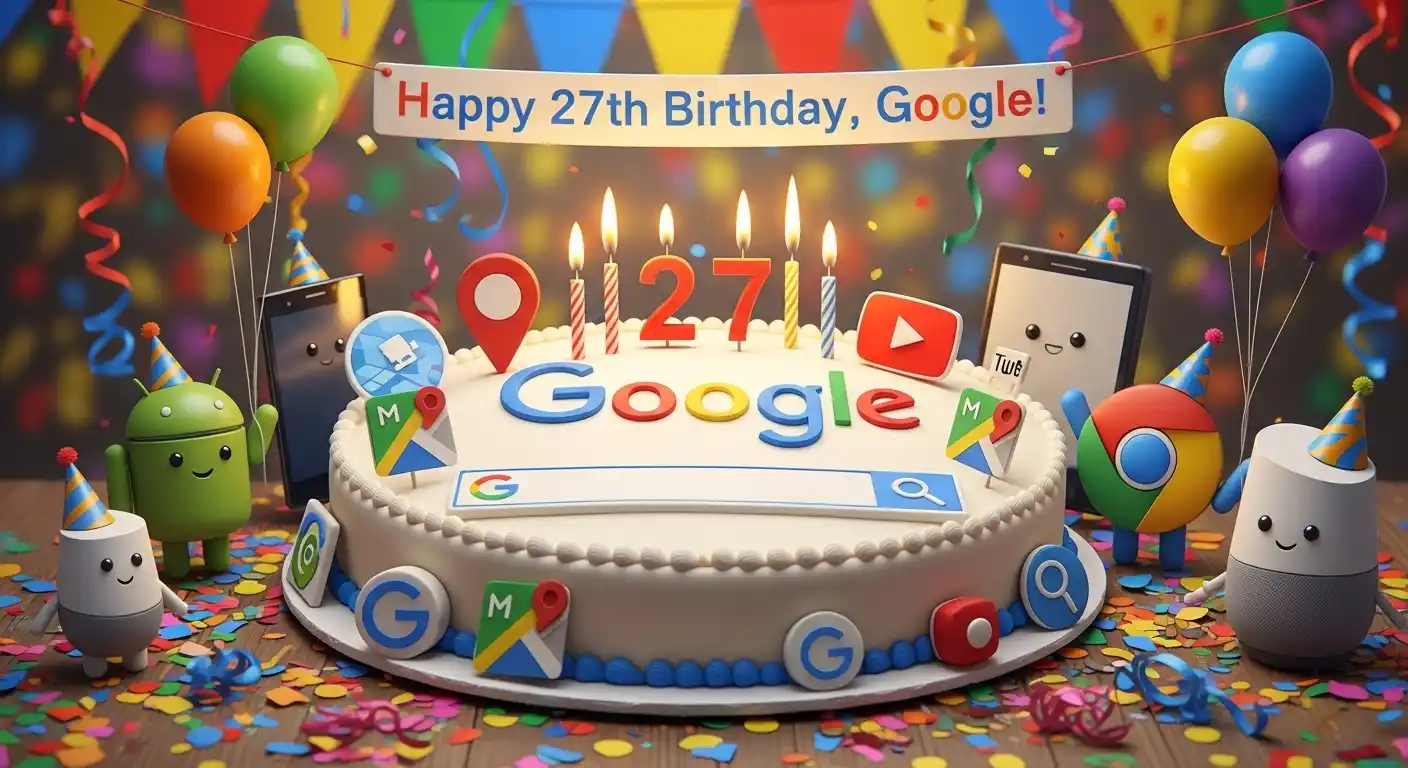

Google turned 27 this year, and honestly, it’s hard to imagine the internet without it. Google’s 27th birthday is a perfect moment to look back at how a dorm room project became the backbone of the modern web. From a simple search bar to an empire of products used by billions every single day — what a ride it’s been.
How Google’s 27th Birthday Reminds Us Where It All Started
It was September 1998 when Larry Page and Sergey Brin officially launched Google as a company. Before that, it existed as a research project at Stanford University called “BackRub” — yes, really. The name “Google” itself is a play on “googol,” a mathematical term for the number 1 followed by 100 zeros. The name was meant to reflect their mission to organize an almost infinite amount of information on the web.
Back then, Google was processing around 10,000 search queries per day. Today? That number sits at roughly 8.5 billion searches every single day. That’s not growth — that’s an explosion.
The Early Days: A Garage, a Dream, and a Search Bar
When Page and Brin started out, they were working out of a garage in Menlo Park, California. Their landlord at the time was Susan Wojcicki, who would later become the CEO of YouTube — which Google eventually acquired. Funny how the world works.
The original Google homepage was famously simple. No flashy graphics, no cluttered menus. Just a logo, a search box, and two buttons. That clean design wasn’t just an aesthetic choice — the founders didn’t actually know HTML well enough to build anything more complicated at the time.
Key milestones from those early years:
- 1998 — Google is officially incorporated as a company
- 1999 — The team moves into their first real office in Palo Alto
- 2000 — Google AdWords launches, changing digital advertising forever
- 2001 — Eric Schmidt joins as CEO; Google Images launches after a massive demand spike following Jennifer Lopez’s iconic green dress at the Grammys
- 2004 — Gmail launches and Google goes public on the stock market
Rolls Royce Share Price: What Investors Need to Know
Google’s Product Evolution Over 27 Years
One of the most impressive things about Google is how it never stopped building. It didn’t just stay a search engine — it became an ecosystem.
Products that changed how we live:
- Google Maps (2005) — Navigation for the masses, forever killing the printed road atlas
- YouTube (2006 acquisition) — Now the second-largest search engine in the world
- Android (2007 acquisition) — Powers over 70% of smartphones globally
- Google Chrome (2008) — Became the world’s most-used browser within a few years
- Google Drive (2012) — Made cloud storage accessible to everyday users
- Google Lens (2017) — Brought visual search into the mainstream
Each of these products didn’t just succeed — they reshaped entire industries. That’s not common. That’s historic.
The Numbers Behind 27 Years of Dominance
Let’s talk about scale for a second, because the numbers are genuinely staggering.
- Google holds about 92% of the global search engine market share
- Over 2 trillion searches are conducted on Google every year
- Google’s parent company, Alphabet, is worth over $2 trillion
- Gmail has more than 1.8 billion active users
- Google Maps is used by more than 1 billion people every month
These aren’t just impressive stats — they show how deeply Google has woven itself into daily life across every continent.
Pros and Cons of Google’s 27-Year Reign
No company this large is without its critics. Here’s an honest look at both sides.
Pros:
- Free access to powerful tools — Search, Maps, Docs, Drive, and more, all at no cost to users
- Constant innovation — Google keeps pushing technology forward year after year
- Global connectivity — Helped bring information access to billions of people worldwide
- Developer ecosystem — Android and Google Cloud have created millions of jobs globally
- Reliability — Google’s infrastructure is among the most dependable in the world
Cons:
- Privacy concerns — Google collects enormous amounts of user data, raising ongoing concerns
- Monopoly power — Regulators around the world have launched antitrust investigations
- Ad dependency — Over 75% of Alphabet’s revenue comes from advertising, creating a conflict of interest with organic search results
- Market dominance crushing competition — Smaller search engines and startups often struggle to compete
- Algorithm opacity — Website owners and publishers can be severely affected by search updates they don’t fully understand
Common Mistakes People Make When Thinking About Google
A lot of people have some surprisingly off-base assumptions about Google. Here are a few worth clearing up.
Mistake #1: Thinking Google only makes money from search. Google’s revenue streams now include cloud computing, hardware (Pixel phones, Nest devices), YouTube ads, app store commissions, and enterprise software.
Mistake #2: Assuming “Googling” is the same everywhere. Search results vary significantly based on location, language, and search history. Two people searching the same term in different countries can get very different results.
Mistake #3: Believing Google indexes everything. Google crawls an enormous portion of the web, but there’s a massive “dark web” and deep web that Google doesn’t index at all. The indexed web is just the tip of the iceberg.
Mistake #4: Thinking paid ads rank above everything organically. Paid search results appear at the top, but they’re clearly labeled. Strong SEO can still beat paid placements in terms of click-through rates and user trust.
Best Practices for Getting the Most Out of Google in 2025
Whether you’re a casual user or a business owner, here are some practical ways to use Google more effectively.
- Use quotation marks around phrases to get exact match results (“best coffee shops in Brooklyn”)
- Add a minus sign to exclude words from your results (jaguar -car if you want the animal, not the brand)
- Use “site:” to search within a specific website (site:nytimes.com climate change)
- Try Google Scholar for academic and research-based results instead of regular search
- Use Google Alerts to monitor mentions of your name, brand, or topic of interest
- Explore Google Trends to understand what people are searching for in real time
For businesses, keeping your Google Business Profile up to date is one of the simplest and most effective things you can do for local visibility.
What the Next Chapter Might Look Like
Google at 27 is in a fascinating position. It’s being challenged by AI-powered search tools, shifts in how younger audiences discover content (increasingly through social platforms), and regulatory pressure from governments across the US, EU, and beyond.
But if there’s one thing 27 years of history shows, it’s that Google adapts. The company that started with a search bar now has its hands in quantum computing, self-driving cars through Waymo, healthcare research, and artificial intelligence at a fundamental level.
Whatever comes next, Google will almost certainly be part of it.
Conclusion
Twenty-seven years is a long time in any industry. In tech, it’s practically ancient — and yet Google feels more relevant today than it did a decade ago. From a Stanford dorm room project to a global technology giant, the story of Google is one of the most remarkable in modern business history.
As we mark Google’s 27th birthday, it’s worth appreciating not just how big it’s become, but how much it genuinely changed the way humans access information, navigate the world, and connect with each other. That’s a legacy worth celebrating.
Frequently Asked Questions
1. When is Google’s official birthday?
Google celebrates its birthday on September 27, though it was officially incorporated on September 4, 1998. The September 27 date became the traditional celebration day after some variation in early years.
2. Who founded Google?
Google was founded by Larry Page and Sergey Brin while they were PhD students at Stanford University.
3. What was Google originally called?
Before it became Google, the project was called “BackRub” — named after its technique of analyzing backlinks to rank web pages.
4. How many searches does Google process each day?
Google processes approximately 8.5 billion searches per day, which works out to around 99,000 searches every single second.
5. What company owns Google?
Google is owned by Alphabet Inc., the parent company created in 2015 as part of a corporate restructuring. Alphabet also owns YouTube, Waymo, DeepMind, and several other subsidiaries.
