

You’re staring at your phone, heart racing, wondering if you just missed the most important Zoom call of your quarter. Or perhaps you’re sitting at a gate in Dallas, looking at a boarding pass for an Oklahoma City flight, and the math just isn’t mathing. We’ve all been there—that sinking feeling that you’re an hour ahead or, worse, an hour behind everyone else.
In a world where “remote work” means your boss is in New York and your client is in Los Angeles, the simple question of what time zone is Oklahoma in becomes a high-stakes puzzle. It isn’t just about the numbers on a clock; it’s about your reputation, your travel sanity, and making sure you don’t show up to a closed restaurant after a long day on the I-40.
This guide isn’t a dry geography lesson. It’s your roadmap to mastering the clock in the Sooner State so you can stop second-guessing your calendar.
What Time Zone Is Oklahoma In? The Simple Answer
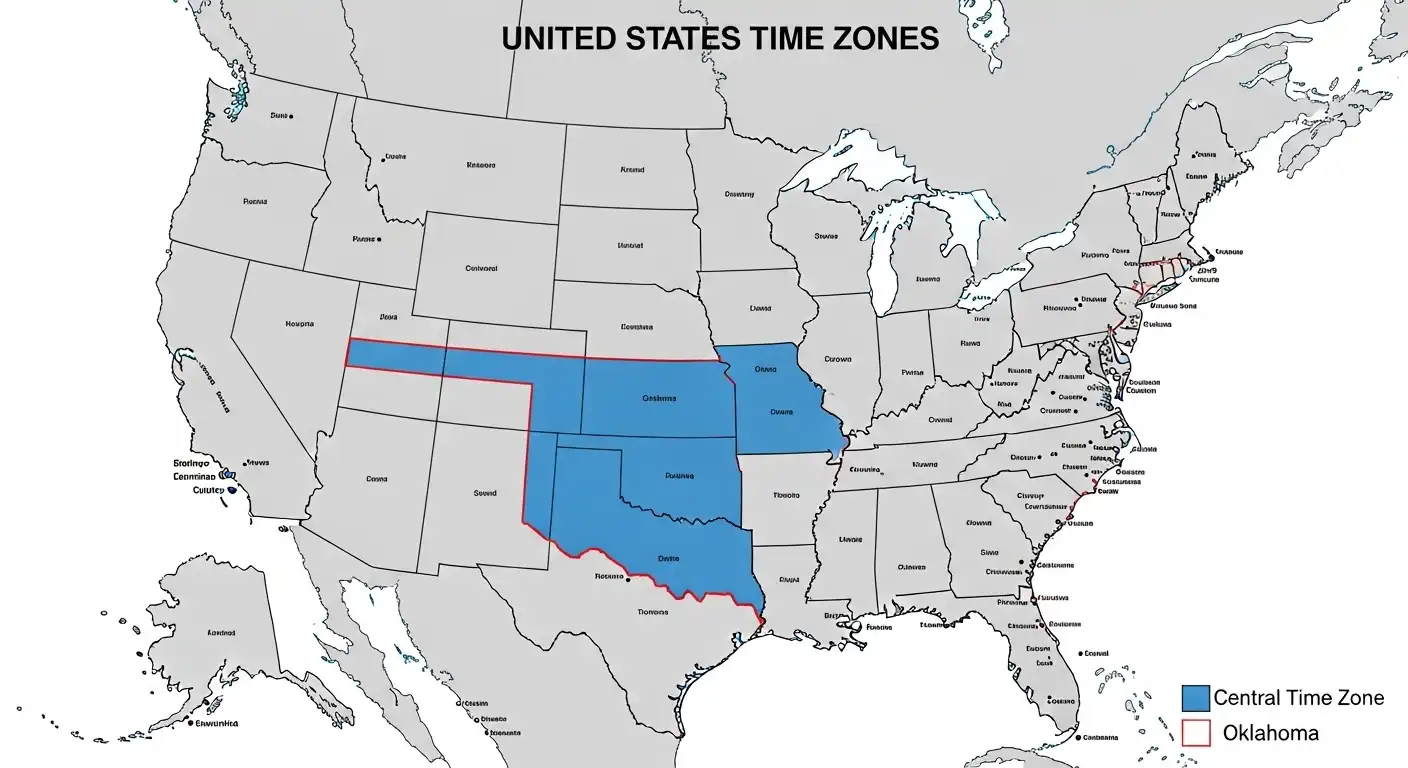
Oklahoma is located entirely within the Central Time Zone. If you are looking for the technical shorthand used by pilots and software developers, the state operates on Central Standard Time (CST) during the winter months and Central Daylight Time (CDT) during the summer.
Unlike some states like Florida, Tennessee, or South Dakota, which are split down the middle by invisible time boundaries, Oklahoma is unified. Whether you are in the tip of the Panhandle near Black Mesa or deep in the Choctaw Nation in the southeast, the time remains exactly the same.
This uniformity is a relief for travelers, but it doesn’t mean mistakes don’t happen. Because Oklahoma sits right on the edge of the “Great Plains” transition, it is very easy to lose track of time if you are heading west toward New Mexico or Colorado.
Oklahoma’s Time Zone Explained with a Real Scenario
Imagine you are a freelance graphic designer living in Guymon, Oklahoma. Guymon is located in the Panhandle—that narrow strip of land that looks like a handle on a pot. You have a 10:00 AM meeting with a printing company just across the border in Clayton, New Mexico.
If you leave Guymon at 9:15 AM for the hour-long drive, you might think you’re going to be late. However, the moment you cross the state line, your phone’s clock will likely “jump” back an hour. Suddenly, it’s 8:15 AM.
While Oklahoma stays firmly in Central Time, its neighbors to the west (New Mexico) and northwest (parts of Kansas and Colorado) operate on Mountain Time. This 60-minute “gift” of time is great when you’re traveling west, but it’s a trap when you’re heading back east. If you leave New Mexico at 4:00 PM for a one-hour drive home, you won’t walk through your front door in Oklahoma until 6:00 PM.
The “Panhandle Trap” is the most common way people get confused about Oklahoma’s time. Even though the state is 100% Central Time, the proximity to the Mountain Time boundary means your smartphone might occasionally “roam” onto a cell tower in a different zone, causing your alarm to go off an hour early or late.
CST to EST Time: The Ultimate No-Stress Conversion Guide
How to Check and Set Your Time in Oklahoma: Step-by-Step
If you are visiting Oklahoma or moving there, you want to ensure your devices are synced correctly. Follow these steps to guarantee accuracy:
-
Identify the Current Season: Check if the U.S. is currently observing Daylight Saving Time (typically from the second Sunday in March to the first Sunday in November).
-
Determine the UTC Offset: * During Standard Time (Winter), Oklahoma is UTC-6.
-
During Daylight Time (Summer), Oklahoma is UTC-5.
-
-
Check Your Device Settings: Go to your smartphone’s “Date & Time” settings. Ensure “Set Automatically” is toggled ON.
-
Verify the Location: If you are near the New Mexico or Colorado borders, manually set your time zone to “Chicago” or “Central Time” instead of “Automatic” to prevent the clock from jumping back and forth.
-
Confirm with an Atomic Clock: If you are performing time-sensitive work (like high-frequency trading or launching a marketing campaign), use a website that syncs with the NIST atomic clock to verify your local Oklahoma time.
Common Mistakes People Make with Oklahoma Time
Even seasoned travelers slip up when it comes to the Sooner State. Here are the most frequent blunders:
-
Assuming the Panhandle is Different: Many people assume that because the Panhandle stretches so far west, it must be on Mountain Time. It isn’t. The entire state, including Kenton and Boise City, observes Central Time.
-
Forgetting the “Spring Forward” and “Fall Back”: Oklahoma observes Daylight Saving Time religiously. If you are coming from Arizona (which mostly does not observe it), you will find yourself an extra hour out of sync during the summer months.
-
Trusting “Automatic” Settings Near Borders: As mentioned, cell towers don’t respect state lines. If you are camping in Black Mesa State Park, your phone might grab a signal from New Mexico and tell you it’s 6:00 AM when it is actually 7:00 AM in Oklahoma.
-
Miscalculating “Central” vs. “Eastern”: Many corporate offices are on the East Coast. People often forget that Oklahoma is one hour behind New York City and Washington D.C. If your boss says “let’s meet at 9,” make sure you know if that’s 9:00 AM ET (8:00 AM in OK) or 9:00 AM CT.
Oklahoma vs. Neighboring States: Time Zone Comparison
Understanding what time zone Oklahoma is in requires knowing how it stacks up against its neighbors. This table shows the relationship between Oklahoma and the states it touches.
| Neighboring State | Time Zone(s) Observed | Relative to Oklahoma |
| Texas | Central & Mountain | Mostly the same; El Paso is 1 hr behind. |
| Kansas | Central & Mountain | Mostly the same; Western Kansas is 1 hr behind. |
| Arkansas | Central | Always the same. |
| Missouri | Central | Always the same. |
| New Mexico | Mountain | Always 1 hour behind Oklahoma. |
| Colorado | Mountain | Always 1 hour behind Oklahoma. |
Pro Tips for Managing Time in Oklahoma
To truly master the clock in Oklahoma, you need more than just a watch. You need a strategy. Here are the insider tips for staying punctual:
The “Chicago Reference” Strategy
When setting up digital calendars like Google Calendar or Outlook, you won’t always see “Oklahoma City” as an option. Always select “Chicago” or “Central Time (US & Canada).” These are the global standards for the zone Oklahoma occupies.
The Sunset Insight
Because Oklahoma is on the western edge of the Central Time Zone, the sun stays up significantly later than it does in Eastern cities like Nashville or Chicago. In the peak of summer, you might see twilight lasting until nearly 9:30 PM in Western Oklahoma. This is a huge perk for road trippers and hikers, providing extra daylight that you won’t find on the East Coast.
Buffer Your Travel
If you are driving from Oklahoma City to Albuquerque, you are “gaining” an hour. Use that hour for a relaxed lunch. If you are driving back, you are “losing” an hour. Always schedule your return trip arrivals 60 minutes later than the GPS suggests to account for the time zone shift.
Frequently Asked Questions
Does Oklahoma have two time zones?
No. Oklahoma is entirely within the Central Time Zone. Unlike some of its neighbors, the state government has never split the state into multiple zones.
What is the time difference between Oklahoma and California?
Oklahoma is two hours ahead of California. When it is 12:00 PM in Oklahoma City, it is 10:00 AM in Los Angeles.
Does Oklahoma City change time in the summer?
Yes. Like most of the United States, Oklahoma City observes Daylight Saving Time. The clocks move forward one hour in March and back one hour in November.
Is Oklahoma in the same time zone as New York?
No. New York is in the Eastern Time Zone, which is one hour ahead of Oklahoma.
What is Oklahoma’s time called right now?
Depending on the time of year, it is either Central Standard Time (CST) or Central Daylight Time (CDT).
Key Takeaways for Your Schedule
Knowing what time zone is Oklahoma in is the first step toward a stress-free trip or a productive work week. Remember these three points:
-
Oklahoma is 100% Central Time.
-
It observes Daylight Saving Time (Spring Forward/Fall Back).
-
Watch out for “time jumps” when traveling west into New Mexico or Colorado.
The next time you’re planning a trip or a call, don’t guess. Open your world clock app, add “Oklahoma City,” and compare it to your current location.
