
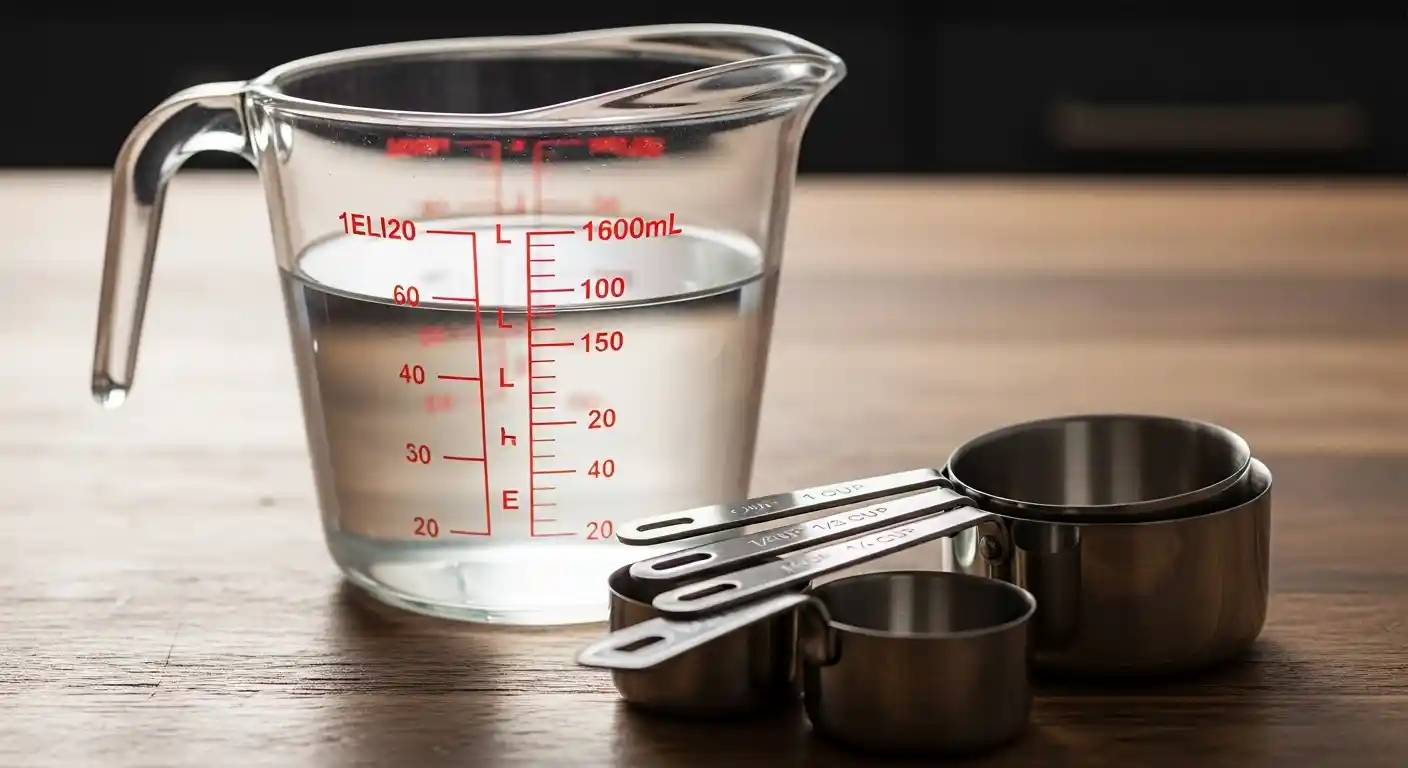

You’re standing in your kitchen, mid-recipe, with flour on your hands and a deadline for dinner. The blog post you’re following calls for 1.2 liters of vegetable stock, but your drawer only holds a scratched plastic set of measuring cups. You start doing mental math, staring at the 1-cup line and wondering if four cups is enough, or if five will turn your risotto into a soggy mess. We’ve all been there—that moment of frantic Googling where a simple dinner feels like a high-stakes chemistry exam.
This isn’t just about math; it’s about the frustration of inconsistent results. Why does your cake come out dry when you follow a European recipe? Why does that “simple” soup feel far too salty? Usually, the culprit is the messy relationship between cups and liters. This guide is designed to strip away the confusion, give you the exact numbers you need, and explain why “one cup” isn’t always what it seems.
What is the Difference Between Cups and Liters?
At its simplest, we are looking at two different languages for the same thing: volume. The liter is the gold standard of the Metric System, used by almost every country on Earth. It is precise, based on decimals, and stays the same whether you are in Paris, Tokyo, or Sydney. One liter is exactly 1,000 milliliters.
The “cup,” however, is a bit of a rebel. It belongs to the Imperial and US Customary systems. While it feels more “homey” and intuitive, it lacks the rigid uniformity of the liter. Depending on where your recipe was written, a “cup” can actually represent several different volumes.
When you are converting between cups and liters, you are essentially translating a flexible, traditional unit into a fixed, scientific one. Understanding this distinction is the first step toward becoming a more confident, “borderless” cook who can handle any recipe from any corner of the web.
How to Get Rid of Gnats in the House: 7 Proven Methods
Cups and Liters Explained: The “Soup Party” Scenario
Imagine you are hosting a dinner party and found a gorgeous recipe for a French Bouillabaisse. The recipe serves ten people and asks for 2.5 liters of seafood broth. You look at your standard US measuring cup. If you assume a cup is roughly 250ml (the “metric cup” standard), you might think 10 cups will do the trick.
But wait—a standard US Customary cup is actually closer to 236ml. If you measure out 10 US cups, you’ve only provided about 2.36 liters. You are now nearly a full cup short of liquid. In a delicate soup, that missing volume means your seasoning will be too concentrated, your fish won’t be fully submerged, and your timing will be off because the liquid will reduce too quickly.
This scenario proves that cups and liters aren’t just interchangeable labels; they are specific quantities that require a bit of precision. Using the wrong “version” of a cup when a recipe expects liters can lead to a domino effect of culinary errors.
Step-by-Step: How to Convert Cups to Liters Like a Pro
If you want to move away from guesswork, follow these three steps to get your measurements right every single time.
-
Identify the Recipe’s Origin: Look at the temperature and weight units. If you see Celsius and grams, the author likely uses the Metric Cup (250ml). If you see Fahrenheit and ounces, they are likely using the US Customary Cup (236.5ml).
-
Use the 0.24 Multiplier for Speed: For most everyday cooking where “close enough” works, multiply your cup count by 0.24 to get the liter equivalent. For example, 4 cups $\times$ 0.24 = 0.96 liters (nearly 1 liter).
-
Use a Graduated Measuring Jug: Instead of dipping a dry cup into a liquid over and over, pour your liquid into a large 1-liter or 2-liter glass jug. Look at the milliliter (ml) markings. This removes the “surface tension” error that happens when you try to fill a small cup to the very brim without spilling.
Common Mistakes People Make with Volume Conversions
The most frequent error is assuming all cups are created equal. In the United States alone, there is a “Legal Cup” (used for nutrition labeling, exactly 240ml) and a “Customary Cup” (used in home kitchens, roughly 236ml). Then there is the “Imperial Cup” used in older British recipes, which is a whopping 284ml.
Another mistake is using dry measuring cups for liquids. Dry cups are designed to be leveled off with a flat edge. If you try to measure a “cup” of water in a dry nesting cup, you will almost certainly spill some before it reaches the pot, or you’ll underfill it to avoid the spill. This might seem minor, but if you do this four or five times for a single recipe, you could be missing 50-70ml of liquid.
Finally, many people forget that liters measure volume, not weight. A liter of water weighs exactly one kilogram, but a “liter” of flour or a “cup” of honey will weigh something entirely different. Always remember that when we talk about cups and liters, we are talking about how much space the ingredient takes up, not how heavy it is.
Cups vs. Liters: Quick Reference Comparison Table
Use this table as your “cheat sheet” when you’re in the middle of cooking. These figures use the standard US Customary Cup (236.5ml) for the most common transition.
| US Cups | Milliliters (ml) | Liters (L) |
| 1/4 Cup | 59 ml | 0.059 L |
| 1/2 Cup | 118 ml | 0.118 L |
| 1 Cup | 236.5 ml | 0.236 L |
| 2 Cups | 473 ml | 0.473 L |
| 3 Cups | 709 ml | 0.709 L |
| 4.23 Cups | 1,000 ml | 1.0 L |
| 8.45 Cups | 2,000 ml | 2.0 L |
| 12.68 Cups | 3,000 ml | 3.0 L |
Pro Tips for Precise Measurement
-
Read at Eye Level: When using a glass liter jug, always bend down so your eyes are level with the meniscus (the curve of the liquid). Looking from above makes the volume appear higher than it actually is.
-
The “Weight” Insight: The secret that most professional bakers use—and the one most articles skip—is that water-based liquids are best measured by weight. If a recipe asks for 1 liter of water, milk, or stock, simply place a bowl on a digital scale and pour until you hit 1,000 grams. This eliminates the “cup vs. liter” debate entirely.
-
Standardize Your Kitchen: If you do a lot of international baking, buy a measuring jug that features both cups and liters on the same vessel. This allows you to cross-reference in real-time without pulling out a calculator.
Frequently Asked Questions
How many cups are in 1 liter?
There are approximately 4.23 US Customary cups in 1 liter. If you are using Metric cups (common in Australia and Canada), there are exactly 4 cups in 1 liter.
Is a liter bigger than a quart?
Yes, a liter is slightly larger than a US liquid quart. 1 liter is about 1.057 quarts.
Why does my 1-liter bottle not fill 4 cups?
If you are using US Customary cups, 1 liter should actually fill 4 cups and leave about 53ml (roughly 3.5 tablespoons) left over. If it fills exactly 4 cups, you are likely using “Metric Cups.”
Can I use a coffee mug as a measuring cup?
Technically no. Most modern coffee mugs hold between 10 and 14 ounces (300-400ml), which is significantly more than a standard 8-ounce (236ml) cooking cup.
How do I convert liters to cups quickly?
A good rule of thumb is to multiply the number of liters by 4 and then add a “splash” extra. For 2 liters, that’s 8 cups plus about half a cup more.
Summary: The Path to Kitchen Accuracy
Navigating the world of cups and liters doesn’t have to be a headache. By understanding that a liter is a fixed metric unit and a cup is a variable traditional unit, you can adjust your cooking style for better results. The key takeaway is to always check the origin of your recipe and, when in doubt, use a graduated measuring jug or a digital scale for maximum precision.
