

You’re staring at your flight itinerary or a new work schedule, and there it is: 18:45. Your brain pauses. You start doing mental gymnastics, subtracting twelve, counting on your fingers, and second-guessing if you’re going to show up six hours late or twelve hours early. That split second of hesitation is frustrating, especially when a mistake means missing a flight, a medication dose, or a critical meeting. You aren’t alone; most of us were raised on the 12-hour cycle, but the rest of the professional world operates on a different rhythm.
This guide isn’t a dry history lesson. It’s a practical manual designed to rewire how you see the clock. We are going to strip away the confusion of AM and PM so you can read military time as naturally as you breathe. By the end of this, you won’t just understand the system—you’ll prefer it.
What is Military Time?
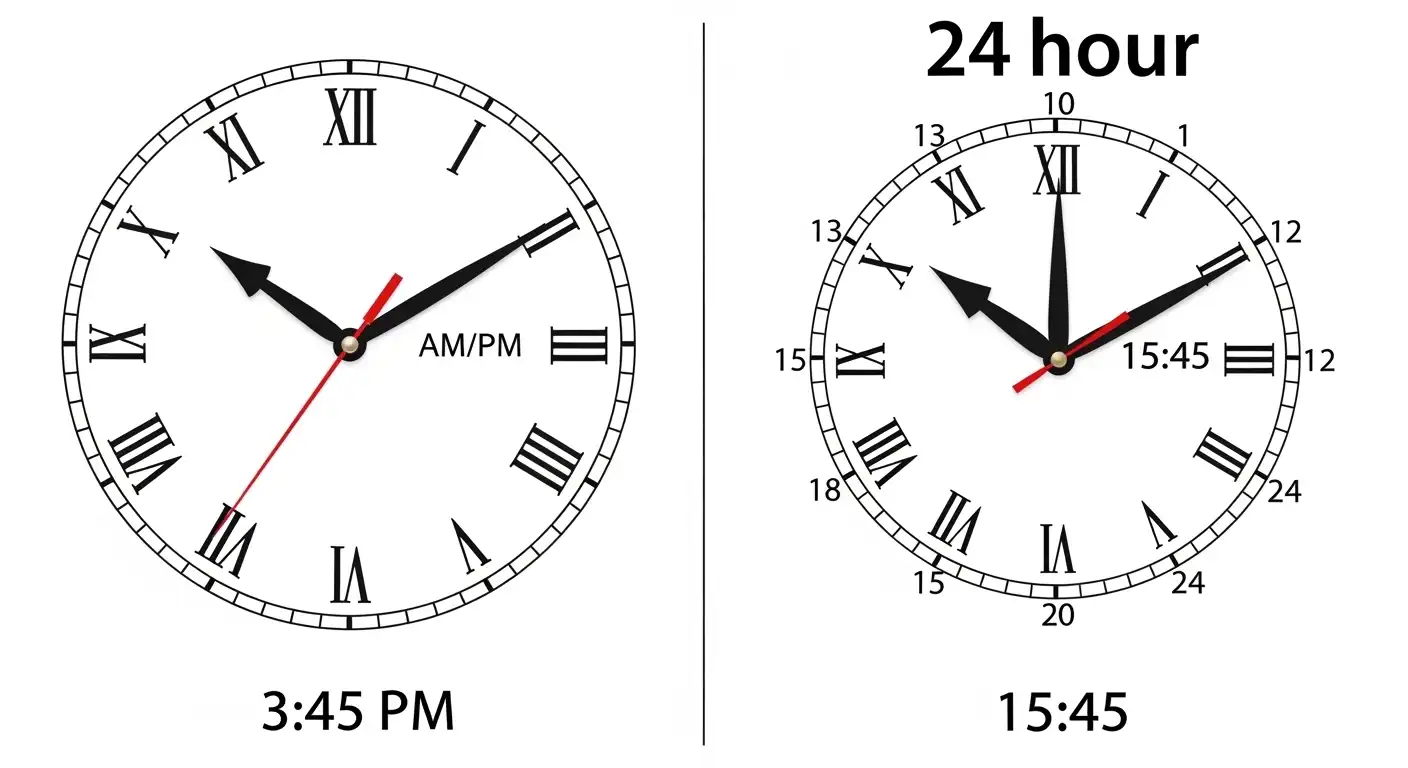
In plain English, military time is a way of telling time that uses a 24-hour scale instead of repeating 1 to 12 twice a day. In the standard system most people use in North America, we hit 12:00 noon and then start back over at 1:00. This requires us to add “AM” or “PM” so people know if we’re talking about breakfast or a midnight snack.
Military time eliminates those labels entirely. The day begins at midnight as 0000 and ends at the final minute of the day, 2359. Every hour has its own unique number. There is no “6 o’clock” in the morning versus “6 o’clock” in the evening. There is only 0600 and 1800. It is the global standard for precision, used by hospitals, pilots, and emergency services to ensure there is zero room for error.
Military Time Explained with a Real-World Scenario
Imagine you are a nurse working a double shift at a busy metropolitan hospital. You have a patient who needs a specific dose of heart medication at 8:00. If the chart just says “8:00,” and the previous shift nurse was exhausted, a catastrophic error could occur. Did the patient get it at 8:00 AM? Is the next dose at 8:00 PM?
Now, look at that same scenario using the 24-hour clock. The chart says the medication was administered at 0800. The next dose is clearly marked for 2000. There is no ambiguity. There is no “I thought you meant tonight.”
The numbers tell a story of a continuous journey from the start of the day to the end. When you see 2000, you immediately know you are eight hours past noon. You don’t have to look out the window to see if the sun is up to know what part of the day it is. This unambiguous clarity is why the most high-stakes professions in the world refuse to use anything else.
Slope Unblocked Game: The Ultimate Guide to Surviving the Neon
How to Convert to Military Time: Step-by-Step
Converting time doesn’t require a calculator, just a simple mental habit. Here is the foolproof way to switch between the two systems without getting a headache.
Converting AM to Military Time
-
Keep the hours the same for any time between 1:00 AM and 12:59 PM.
-
Add a leading zero if the hour is a single digit (e.g., 5:00 AM becomes 0500).
-
Special Case: Midnight (12:00 AM) becomes 0000.
Converting PM to Military Time
-
Add 12 to any hour from 1:00 PM to 11:59 PM.
-
Remove the colon and the “PM” label.
-
Example: If it is 4:00 PM, calculate $4 + 12 = 16$. Your time is 1600.
Converting Military Time back to 12-Hour Time
-
If the number is 1300 or higher, subtract 12. (e.g., 1700 – 12 = 5:00 PM).
-
If the number is between 0100 and 1159, it is simply AM time.
-
If the number starts with 00, it is the hour after midnight (e.g., 0030 is 12:30 AM).
The golden rule is the “12 Plus” method. If the sun has passed its highest point in the sky, just add 12 to whatever the clock says.
Common Mistakes People Make
Even after learning the basics, beginners often trip over a few specific hurdles. Avoiding these will make you look like a seasoned pro.
-
The “Twelve” Confusion: Many people try to add 12 to 12:00 PM (noon). Don’t do that. 12:00 PM is simply 1200. If you added 12, you’d get 2400, which actually refers to midnight (the very end of the day).
-
Saying “O’Clock”: In military parlance, you don’t say “o’clock.” You say “hundred.” 0800 is “zero eight hundred.” 1700 is “seventeen hundred.”
-
The Leading Zero: In the 12-hour system, we often write “9:00 AM.” In military time, you must include the zero (0900). Skipping that zero can lead to formatting errors in digital systems.
-
Confusing 0000 and 2400: While they represent the same point in time (midnight), 0000 is usually used to mark the start of a new day, while 2400 is used to mark the end of the current day. Most digital clocks will flip from 23:59 to 00:00.
Military Time vs. 12-Hour Clock: Comparison Table
| 12-Hour Time | Military Time | Pronunciation |
| 12:00 AM (Midnight) | 0000 | Zero Hundred |
| 3:00 AM | 0300 | Zero Three Hundred |
| 9:00 AM | 0900 | Zero Nine Hundred |
| 12:00 PM (Noon) | 1200 | Twelve Hundred |
| 1:00 PM | 1300 | Thirteen Hundred |
| 5:30 PM | 1730 | Seventeen Thirty |
| 8:15 PM | 2015 | Twenty Fifteen |
| 11:59 PM | 2359 | Twenty-Three Fifty-Nine |
Pro Tips for Mastering the 24-Hour Clock
If you want to stop “translating” in your head and start “thinking” in 24-hour format, use these strategies:
Change Your Phone Settings First
This is the single most effective way to learn. Go into your smartphone’s “Date & Time” settings and toggle on the 24-hour format. Because you check your phone dozens of times a day, your brain will be forced to internalize the values of 1500, 1900, and 2200 through sheer repetition.
Use the “Double-Digit” Anchor
Memorize three anchors: 1500 (3 PM), 1800 (6 PM), and 2100 (9 PM). If you see 1900, you know it’s just one hour past 1800 (6 PM), so it must be 7 PM. This bracketed thinking is much faster than doing subtraction every time.
Think in Durations
Military time makes calculating duration much easier. If a shift starts at 0830 and ends at 1700, you just subtract: $1700 – 0830 = 8.5$ hours. You don’t have to worry about crossing the “noon barrier” which often confuses people when they try to calculate hours between AM and PM.
Frequently Asked Questions
Is 24:00 a real time?
Technically, yes, but it is rarely seen on digital clocks. 24:00 refers to the exact end of the day. As soon as one second passes, it becomes 00:00:01 of the next day. Most computers and watches use 00:00.
Why do some people say “hours” after the time?
In some professional settings, people will say “eighteen hundred hours.” This is simply a formal way to clarify that they are speaking in military time, though in casual conversation among those who use it daily, the word “hours” is often dropped.
How do you say 0005?
You would pronounce this as “zero zero zero five” or “zero zero zero five hours.” In some circles, it’s also called “five hundredths.”
Do other countries use military time?
Yes. In fact, most of the world (Europe, Asia, Africa, South America) uses the 24-hour clock as their standard for everything from train schedules to television listings. The US is one of the few places where the 12-hour clock remains the primary civilian standard.
Is there a difference between 24-hour time and military time?
They are nearly identical. The only real difference is the formatting. Military time usually omits the colon (1800), while standard 24-hour time used by civilians in Europe often includes it (18:00).
Conclusion
Learning to read military time is like learning a second language that only has 24 words. It feels clunky for the first few days, but once it clicks, you’ll realize it is a much more logical way to organize your life. It removes the risk of “AM/PM” errors, streamlines your travel, and aligns you with the global standard of professional communication. The most important thing you can do right now is change the clock on your phone or computer to the 24-hour format. Live with it for one week, and you’ll never want to go back to the confusion of the 12-hour cycle again.
